
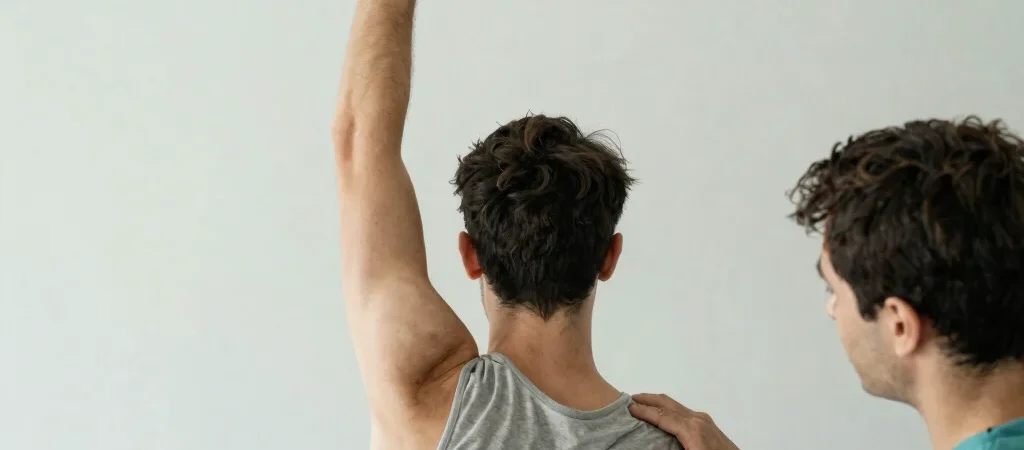
Reaching into a cupboard looks simple, but the arm has to move while the shoulder remains controlled. The rotator cuff is part of that system: four muscles and their tendons contribute to shoulder movement and help manage the position of the humeral head as the arm moves. Knowing that role gives the term “rotator cuff” a useful connection to function.
Four muscles, shared work
The supraspinatus, infraspinatus, teres minor, and subscapularis are the four rotator cuff muscles. Their tendons attach around the head of the humerus, with different muscles contributing to actions such as lifting and rotating the arm. They do not work in isolation: the deltoid, shoulder blade muscles, and trunk also contribute to reaching.
Symptoms need context
Shoulder pain during lifting does not, by itself, identify a rotator cuff injury. Similar symptoms can come from different tissues or movement-related factors, and imaging findings do not always explain how much discomfort someone has. A clinical assessment connects the person’s history with movement, strength, and the tasks that have become difficult.
Rehabilitation follows function
Rehabilitation often uses progressively challenging movement and resistance to rebuild the shoulder’s capacity for relevant tasks. The starting point might be a comfortable range of motion or a light rotation exercise; later steps may involve lifting, carrying, or work and sport demands. The right progression depends on the individual’s presentation and response, rather than a single exercise being right for every shoulder.